Antlion / Components / Custom Seat
Custom SeatSEAT-002
Same seat placement as Seat, but the vomitories, aisles and even the seats come from curves you draw instead of being generated. Use it where the automatic layout cannot express what you want.
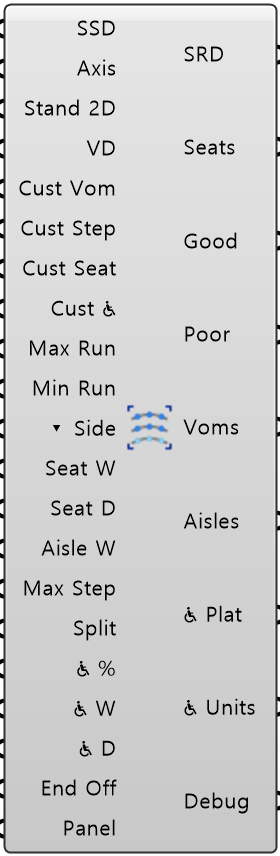
Ports with a dark edge and line carry the chain from one component to the next. The rest are values you set once. Inputs marked ▾ take a Value List: wire one in and it fills with the choices.
Inputs
- Stand Sections
SSDThe tier sections, passed along the chain. Wire from Stand 2D SSD - Axis
AxisThe axis system from Stand 2D. Without it, curves are found from turn angles - Stand 2D
Stand 2DThe tread rings seats are placed on. Wire from Stand 2D - Vomitory
VDOptional. How each tier gets down to the concourse - Vom Type Mode, drops, landings and clearances from Vomitory - and what sits in front of each mouth (Vom Type Mode 5-7). Only these settings are used: your Custom Voms stay exactly as drawn, each one is given its tier's stair, stepped or ramp descent, and a deck or pocket in front of its mouth when the tier asks for one. Wire from Vomitory VD - Custom Voms
Cust VomOne branch per tier. Draw each opening over the treads it spans: a closed rect, a band along the rings - a rect that crosses an axis line where the rings turn less than 30 degrees, or one bent along the rings (4 corners, plus 2 per bend) - split into rects at the axis lines or bends, doors at both ends of the band - Vom 3D's Band Opening Mode can keep one, or a U-shaped outline (arms at or inside the bar's ends - split into arm, bar and arm). A rect over an axis line where the rings turn 30 to 60 degrees stays one opening. Two rects may share a segment only on different rows - Custom Steps
Cust StepOne branch per tier. Feed baked Aisles cells back, or draw your own - open curve = the aisle centerline; closed outline = the aisle cells over the treads it covers. The drawn shape is kept at an axis line where the rings turn 30 degrees or more, when wider than 1.5 times Aisle Width, with more than four corners (bends under 30 degrees don't count) or with its front and back edges along the rows; any other outline is squared to its rows - Custom Seats
Cust SeatOne branch per tier. A tier given seats here is only judged, not laid out - Custom Wheelchair Spaces
Cust ♿One branch per tier. Draw each accessible space - wheelchair and companion alike - exactly where you want it. The rects are kept as drawn, seats underneath are removed, and automatic wheelchair units are replaced by yours - the accessible row itself stays cleared and merged - Max Seats Per Run
Max RunLongest run allowed when spectators can leave from both ends (default 28) - Min Seats Per Run
Min RunShortest run worth keeping. Anything shorter is flagged POOR (default 4) - Aisle Side Mode
▾ SideWhere the end aisles go: BOTH, LEFT, RIGHT or NONE - one per tier, the last value fills the rest (default BOTH) - Seat Width
Seat WWidth of one seat (default 500 mm) - Max Seat Width
Max WLets the seats Custom Seat places widen up to this width so each row fills out between its aisles - Seat Width becomes the narrowest. Each row between two aisles keeps the seat count Seat Width gives and takes the widest standard width those seats fit in, from Seat Width up to this one, in steps of 1 in (inch files) or 10 mm (metric files). Rows are fitted one by one, so with Aligned the columns can drift where rows widen. Only rows with a straight aisle, an end aisle or a seat width zone line at both ends widen - rows that end at a vomitory keep one width, and seats you drew keep theirs. Inside a zone from Bowl Zone that sets its own Seat Width or Max Seat Width, the zone's values are used instead. Leave empty to keep one width - Seat Depth
Seat DDepth of one seat (default 500 mm) - Aisle Width
Aisle WClear width of each aisle (default 1000 mm) - Max Riser Step
Max StepComfortable rise per aisle step. Taller risers get up to 2 steps, more on treads deep enough for them (default 180 mm) - Aisle Split Mode
SplitAdd a mid aisle to runs still too long. Tiers with Custom Steps use only your aisles (default true) - Wheelchair Ratio Target
♿ %Target share of wheelchair spaces, percent of capacity. Reporting only (default 0) - Wheelchair Space Width
♿ WWidth of one wheelchair space. 900 mm follows FIFA and EN 13200-1, 36 in follows ADA (default 900 mm) - Wheelchair Space Depth
♿ DDepth of one wheelchair space. 1400 mm follows FIFA and EN 13200-1, 48 in follows ADA (default 1400 mm) - End Offset
End OffHow far each open end of the stand moves past its end axis - one value for both ends. Positive carries the stand on in a straight line and fills the new length with standard seats, negative pulls the whole stand back (seats, treads and body). Use + on one stand and - on its neighbor to meet on the same line. 0 = end on the axis. A closed bowl has no open ends (default 0) - Zones
ZonesZones from Bowl Zone - merge as many as you like. A zone only puts seats in or takes them out; the stand, the wheelchair platform and the vomitory mouths stay as they are. Each zone does what its seat inputs say, tier by tier. Remove Wheelchair: the wheelchair spaces and companion seats inside the zone are left out - a tier where you drew Custom Wheelchair Spaces keeps what you drew. Clear All Seats: every seat inside the zone is left out. Clear Front Rows, Clear Rear Rows: that many rows from the front or the top of each tier are left without seats - for cameras, equipment or anything you model yourself; treads and aisles stay. Seat Width: the seats Custom Seat places inside take that width, changing at the zone's axis lines - where zones overlap, the later one wins. Empty = none - Seat Layout
▾ LayoutHow the seats Custom Seat places fill each row - seats you drew stay as drawn. Aligned keeps seats in the same columns from row to row, taking the top row as the guide - next to a slanted aisle a row can come out one seat short, and rows a zone's Max Seat Width widens are fitted on their own (default). Most Seats fills every row on its own with as many seats as fit - more seats, but the columns can drift from row to row - Panel Values
PanelEvery value from Input Panel, as one bundle. Anything you wire in yourself wins over it
Outputs
- Seat Result
SRDThe whole 2D layout as one object. Wire into Cut, Stand 3D Plus or Vom 3D - Seat Rects
SeatsOne branch per tier. Every seat as a rectangle in plan - Good Seat Rects
GoodOne branch per tier. Seats in runs that meet the egress rules - Poor Seat Rects
PoorOne branch per tier. Seats in runs that break the rules - Vom Rects
VomsOne branch per tier. Your vomitory footprints as actually applied - Aisles
AislesOne branch per tier. The aisle floor as cells, tread by tread - intermediate steps where the riser needs them (up to 2, more on deep treads), one full-tread cell where it does not - Wheelchair Platforms
♿ PlatOne branch per tier. The level platform an accessible row sits on - Wheelchair Units
♿ UnitsOne branch per tier. Two rects per unit - wheelchair space, then companion seat - Debug
DebugDeveloper diagnostic output for tracking down bugs. Copy this when reporting a problem
What it does
A tier given all three of vomitories, aisle cells and seats is taken as complete, and Custom Seat adds nothing of its own there - no automatic aisle beside a vomitory and no aisle carried up to the top row - so every aisle you want has to be drawn. Aisle cells drawn inside a vomitory passage or its entry band are removed, with an orange warning that gives the row and position.
A tier missing any of the three is filled in as before, with one exception: once you draw aisle cells on a tier, they are its only aisles. No automatic aisle is added there, and a run still longer than Max Seats Per Run shows in Poor Seat Rects with a white remark that gives the row and position - it is your layout to judge, not an error. Wheelchair spaces are optional either way.
A vomitory band bent along the rings opens at both of its ends; which end keeps its door is chosen on Vom 3D, with Band Opening Mode.
- Component
- SEAT-002
- Ribbon
- Bowl ▸ Section 3
- Tier
- core
- Ports
- 24 in · 9 out
- Version
- 1.2.1
- Checked
- 2026-11-19